

Brickwork repointing in London
Failed and eroded mortar joints raked out and repointed in a mix that suits the original brickwork — because the wrong mortar damages brick faster than no mortar at all.
- Lime and cement-based mixes
- Period and modern brickwork
- Chimneys, parapets and elevations
- Free, no-obligation quotes
400+ Five-star reviews
Across Google, Checkatrade, TrustATrader & MyBuilder
30+ Years of experience
Roofing and exterior property care across the capital
25 yr Guarantee
Backed by premium materials and skilled workmanship
Free No-obligation quotes
Clear, itemised pricing with no hidden costs


Getting the mix right
The mortar should always be softer than the brick
Mortar is designed to be the sacrificial part of a wall. It takes the movement, absorbs the moisture and erodes slowly so the bricks do not have to. Repoint a soft Victorian stock brick with a hard modern cement mortar and you reverse that: the water has nowhere to go but through the brick face, which then spalls and crumbles instead.
So the first question on any repointing job is what the wall was originally built in. On older London stock brickwork that usually means a lime-based mix. We rake out to a proper depth rather than skimming the surface, brush and wet the joints, and finish to match the original profile — struck, bucket-handle or flush — so the elevation still looks like itself when we have finished.
- Mix matched to the original mortar and brick
- Joints raked to depth, not skimmed over
- Lime mortar used where the building needs it
- Original joint profile matched on the finish
Where we repoint
Every joint that lets water in
Repointing is rarely a whole-house job. It is usually the exposed areas that have taken the most weather.
Full elevations
Weather-facing walls raked out and repointed where erosion has run across the whole face.
Chimney stacks
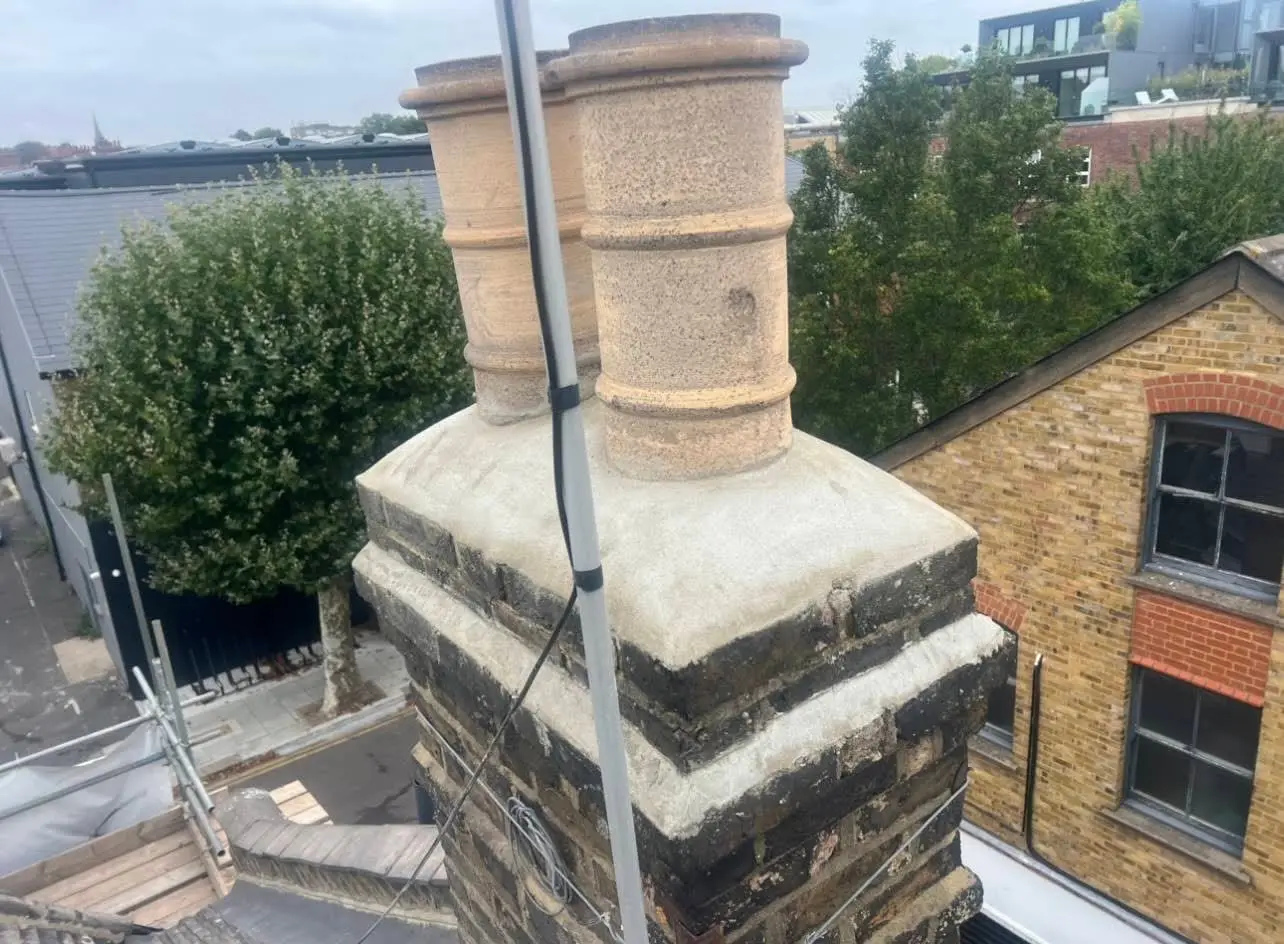
The most exposed brickwork on any building, and usually the first place mortar washes out completely.
Parapets & copings
Parapet walls and coping joints, a very common route for water into the top of a London terrace.
Spot repointing
Localised areas cut out and made good where the rest of the elevation is still sound.
Lime pointing
Traditional lime mortars on solid-wall and period properties, allowing the wall to breathe as it was built to.
Brick replacement
Spalled and frost-damaged bricks cut out and replaced with matched stock as part of the same visit.
What to look for
Signs your brickwork needs repointing
Most of this you can check from the ground with nothing more than a set of keys and a close look.
- Mortar you can rake out with a key or a fingernail
- Joints noticeably recessed behind the brick face
- Sand or grit collecting on sills and at the base of the wall
- Brick faces flaking, blistering or crumbling away
- Damp patches inside on an exposed elevation
- Vegetation or moss taking root in the joints
- Previous repointing that is cracking away from the brick
Bricks spalling is a sign the pointing has already been left too long, or was done in too hard a mix. Worth a look sooner rather than later.
How it works
Five steps, no surprises
The same straightforward process whether you need a single tile replaced or an entire roof rebuilt.
- 01
Get in touch
Call, email or WhatsApp us with what you have noticed. We will ask a few questions to understand the property and how urgent it is.
- 02
Free inspection
We come and look properly — including up on the roof where it is safe to do so — and photograph anything that needs your attention.
- 03
Written quote
You receive a clear, itemised quotation explaining the work, the materials and the price. No obligation, no pressure.
- 04
The work
Our own team carries out the job to the agreed programme, keeping you updated with photos and leaving the site clean each day.
- 05
Sign-off & guarantee
We walk you through the finished work, share before-and-after photos and confirm the guarantee that applies to your job.
Brickwork Repointing FAQs
Your questions, answered
The questions we get asked most about this work. If yours isn't here, just ask — we're happy to explain.
How long does repointing last?
A correctly matched and properly applied repoint should give you 50 years or more on a sheltered elevation, and rather less on a wall that takes driving rain. Poorly executed repointing in the wrong mix can start failing within five, which is why the mix and the raking depth matter so much.
What is lime mortar, and why would I need it?
Lime mortar is softer and considerably more breathable than modern cement mortar. Older solid-wall buildings were built to let moisture move through the mortar and evaporate. Pointing them in cement traps that moisture in the brick, which then spalls in frost. If your property is Victorian or older, lime is usually the right answer.
Can you just point over the old mortar?
No, and anyone offering to is not doing you a favour. A thin skim over eroded joints has nothing to grip and will crack and drop out within a couple of years. Joints need raking out to roughly twice their width in depth so the new mortar has something to key into.
Will repointing stop my damp problem?
It can, where the damp is caused by water tracking through open joints on an exposed elevation. It will not touch damp caused by a failed gutter, a bridged cavity or ground moisture. We look at what is actually causing it before recommending the work.
Can you match the existing pointing?
Yes — both the colour and the profile. Sand choice drives most of the colour, and we match the joint finish to what is already there so a repaired section does not stand out from the rest of the wall.
How much of the wall needs doing?
Often less than people expect. It is common for one weather-facing elevation and the chimney to need work while the rest is sound. We will tell you what genuinely needs doing rather than quoting the whole building by default.

Free quote
Mortar washing out of your brickwork?
We will look at the elevation, work out what mix it needs and quote it in writing — free and with no obligation.